Wednesday, February 24, 2016

A Night at the Opera

Many years ago, I was pleased to be a regular panelist judge of high school musicals in friendly competition for Tony-type awards each spring in Pittsburgh. In fairness, the various productions were compared only to others in their budget class; well-funded musicals in wealthy suburban districts enjoyed distinct advantages in hiring professional directors, students often took private singing, dancing. and acting lessons, and stage facilities were held to much higher standards than many small professional companies made do with. In fact, I preferred judging the lowest budget category productions, which relied most heavily on creative solutions to technical issues and could turn on the talents of a single gifted performer.

I was excited to see a local production of Puccini's Turandot last night at the 50-year-old Rubén Darío National Theatre in Managua. Not only was it my first opportunity to hear live classical music in the eight months since I moved here, it was my first visit to the national theatre and a chance to gauge the local appetite for such fare. I did not expect a lavish production, and I found plenty to appreciate.

It surely helps the survival odds of live opera here that the son of President Ortega is a well-trained tenor with a growing repertoire who has trained at the Verdi Conservatory in Milan. For this production, Laureano Ortega was cast in the male lead as the mysterious prince who comes to Peking to woo the cold-hearted princess. The role of Turandot, daughter of the emperor, was also  played by a Nicaraguan artist, Elisa Picado, in a pairing reminiscent of Dame Joan Sutherland and her slender swains in "Daughter of the Regiment." Mr. Ortega cuts a fine, if diminutive figure on stage, where he was apparently given little direction beyond striding slowly and purposefully to his next mark.

Laureano Ortega as Prince Calaf (Photos by Noel Carcache)


Was there ever a sillier premise for an opera than an ice princess who demands the solving of three riddles to win her hand, and death to those who fail? Why would the prince want such a vexatious beldam in the first place?  A trio of "ministers," Ping, Pang, and Pong, in Puccini's politically very incorrect times, have some of the best vocal material, and all three were portrayed by Italian opera veterans. A slave girl, Liu, was also portrayed by an Italian soprano, and was just sensational.


L-R Tiziano Barontini, tenor; Elizabetto Zizzo, soprano; Raffaele Raffio, baritone; and Ugo Tarquini, tenor.


Mr. Ortega is not blessed with a brilliant tenor, but rather a warm expressive tone, and the conductor should have held back the orchestra, which too often overwhelmed. The gorgeous "Nessun Dorma," Turandot's most famous aria, was nicely realized, and received the biggest ovation of the evening for Ortega. Ms. Picado has a vibrato we used to say, "you could drive a truck through," and wobbles about the correct tonality at times. Neither of the romantic leads displayed much acting ability, but this is opera, and the music is everything. The chorus was fine, if zombie-like, and the orchestra was wonderful, with many pristine solos. I was thrilled to hear Puccini's last work, which, like Madama Butterfly, is heavily influenced by Eastern musical scales and themes. So beautiful.

Laureano Ortega as Prince Calaf and Elisa Picado as Turandot

Thursday, February 18, 2016

Odd Juxtapositions

Here are a pair of post-scripta that deserve to be included and may be filed under "odd juxtapositions."

Yesterday, we lost our electricity for most of the day. Before we lost power, I had noticed a couple of plump ticks attached to Brynn, and as she is highly distrustful of my efforts to sneak up and pull them off, I dosed her with a teaspoon of children's benedryl. I  planned to do a load of laundry in the morning and hoped she would doze off at some point. No power equals no washing machine, so I settled myself in the hammock with my Nexus to continue the F. Scott Fitzgerald novel (This Side of Paradise) I'd started the night before, only to find that my Nexus was itself out of energy. Great, I grumbled. I'll have to get a real book.

I did manage to cart a few boxes of old faves and classics to Nicaragua, and, why, if it wasn't old Homer calling out to me! I opened The Odyssey, to find that I had inadvertently filched a high school debate team gift to my son from his team advisor (and wonderful English teacher), Mrs. Bowman. I happily cracked its spine, perused the forward, and launched myself into the absolutely worst trip home ever.

Just as Telemachus was setting sail for Pylos in search of word of his father's whereabouts, I noticed that Brynn was sleeping deeply nearby on the porch. I quietly attached a leash to her collar JUST IN CASE and then chickened out and asked Salvador, our cuidador, to try and remove the ticks, one of which was attached to HER EYE! Of course she woke up and struggled to get away and showed her teeth and growled, but Salvador has a way with dogs. He calmed her and deftly pulled out the tick from the eye. Which immediately began dripping blood -- the eye, not the tick. I raced for wet paper towels and Brynn actually allowed me to put some pressure on her eye, and all was solved. She even let Salvador to remove the other tick without complaint.  And unlike Odysseus, I did not anger Poseidon for shoving a hot poker into the eye of Polyphemus. Just mopped up a little blood and all was well.

Today, I did yesterday's laundry, put it on the line, and grabbed a bus to Diriamba to pick up a few necessities. When I settled my self and my shopping bags into a seat for the return trip, I opened my now-charged Nexus and rejoined the aforementioned F. Scott Fitzgerald. As the bus filled up -- it has a slot at the Diriamba mercado, and does not leave for La Boquita until the bus is full-- somebody in the rear had a rooster in a covered basket, and an evangelist got up in the front to begin his cant, as they do. A group of children giggled when the rooster crowed, and I do not think anyone was actually listening to the man with his Bible, but after about ten minutes, he finished his lecture, and thanked everybody for their attention. There was a moment of silence, and then the rooster crowed very loudly, and the whole bus laughed. The motor started and we began the trip home. It was not easy getting back to daiquiris and foxtrots, I promise you.


Tuesday, February 16, 2016

February Blows

The month is half-gone and I have yet to post a damned word. I find nothing of sufficient interest to merit my own notice, let alone yours.

It has been a very windy, dirty two weeks. Actual dunelets of windborne dust appear daily on the floors, along with leaves, dead insects, bougainvillea blossoms. Several times a day, I shake out my bed coverlet and sweep the bedroom floor. The dust is prodigious! The wind continues through the night, which finds me nose-deep in polvo when I wake up. The wind keeps both the heat and the mosquitoes at bay, so there is an upside to all the grit and dust that blankets everything.

Some of my time has been occupied with sorting out tax forms and retirement savings. I spent a whole morning in Diriamba walking from one "Fax Available" storefront to the next, only to find not one functioning machine.

Reading remains my salvation. The four Neapolitan novels of  Elena Ferrante are packed with the denizens of a single neighborhood; their entanglements with good and ill fortune and each other are absorbing and shocking in equal measure. Now I am halfway through "The Door," by Magda Szabo, which has apparently become a Helen Mirren film. Yum.

This Sunday, I have a ticket to see "Turandot" in the Ruben Dario National Theatre in Managua. I think it is a local production with lead singers imported from Italy. Report to follow.

Word from Pennsylvania regarding my house sale is depressing beyond belief. Not only does no one want to buy it, but someone has helped himself to the copper piping. This definitely was not part of the plan. I begin to understand why so many houses fall into neglect. People work rather diligently to forget they ever existed.

Friday, January 29, 2016

Walking the Walk

Exercise and I have never have never achieved any sort of comfort level together. I have always accepted the importance of physical workouts for a healthy body, just as I have never doubted the need to floss my choppers. Acceptance of these truths has yielded only sporadic adjustments in both cases to my preferred, rather slothful, pace of living. When I quit smoking 15 tears ago, I wondered if my increased lung function would lift that indolent veil and find me leaping, sylph-like, from one cardio-positive nostrum to the next, brimming with vitality. Alas, no, my cigarette-less oral fixation leapt, slug-like, instead, to eating and drinking to excess, until I leveled off some 50 pounds heavier.

Here, now, in this tropical clime, I have embraced the slower pace that comes with the heat of the Nicaragua sun. Here, we do not hustle. Ever. We amble, we mosey, we sashay, and sometimes, we even move so slowly that we actually stop, especially under the odd shade tree, until we resume movement toward some eventual end.

The only time of day in which purposeful locomotion is at all feasible is at about 5:30 in the morning. For about an hour, it is almost cool. Not only that, but the street is empty, save for the occasional pig or skinny dog, and Brynn and I can hoof the mile to the beach at La Boquita and put our toes in the surf for a few minutes before we reverse course for home. My wretched knees complain, the sun hits its stride, and the world wakes up before we arrive back at the house, but I feel so virtuous that I almost immediately decide to do it all again the next morning.

Here is the little pizza place just down our road, open Thur-Sun. The pizza is simply delicious!

A little further along is this hostel, with a "siesta rate" (see canoe) of 200 cordobas ($7.50) for a 
four-hour "no tell motel" arrangement.


This is the entrance to the tourist center of La Boquita, with a "pulperia" that sells no rum or cigarettes, which is the only reason to go to a pulperia.


Earthquakes create tsunamis, and La Boquita had a tsunami back in 1992, I believe. Hence, the warning to beach goers.


Brynn and I go right through this pavilion to the sea beyond.


Yesterday, we encountered a terrestrial crab on the roadside. It is sitting on the tree root 
in the middle of the photo.


Thursday, January 21, 2016

Diriamba Puts on Her Party Dress


The Lives of the Saints was required (and often deliciously lurid) reading for young Catholic girls like me way back in the day, and few stories could match that of St. Sebastian for sheer drama and a grisly martyrdom.

He was a third-century Christian who entered the Roman army in order to protect martyrs. He refused to sacrifice to Roman gods, and was imprisoned, but managed to convert the right people and was released, and he continued to serve in the Praetorian Guards under Diocletian. He kept his faith under wraps, but was eventually outed and tied to a post where "the archers shot at him till he was as full of arrows as an urchin," (Legenda Aurea). He survived, actually, and was nursed back to health, but he publicly denounced Diocletian, who ordered that he be cudgeled to death.
Image result for saint sebastian galleryImage result for saint sebastian gallery

The popular images of St. Sebastian show a young man of (often feminine) physical beauty, eyes heavenward as his arrow-ridden body sags gracefully from the ropes binding him to the post or tree. His feast day is 20 January, which, in Diriamba, is part of a 10-day festival in the saint's name. 

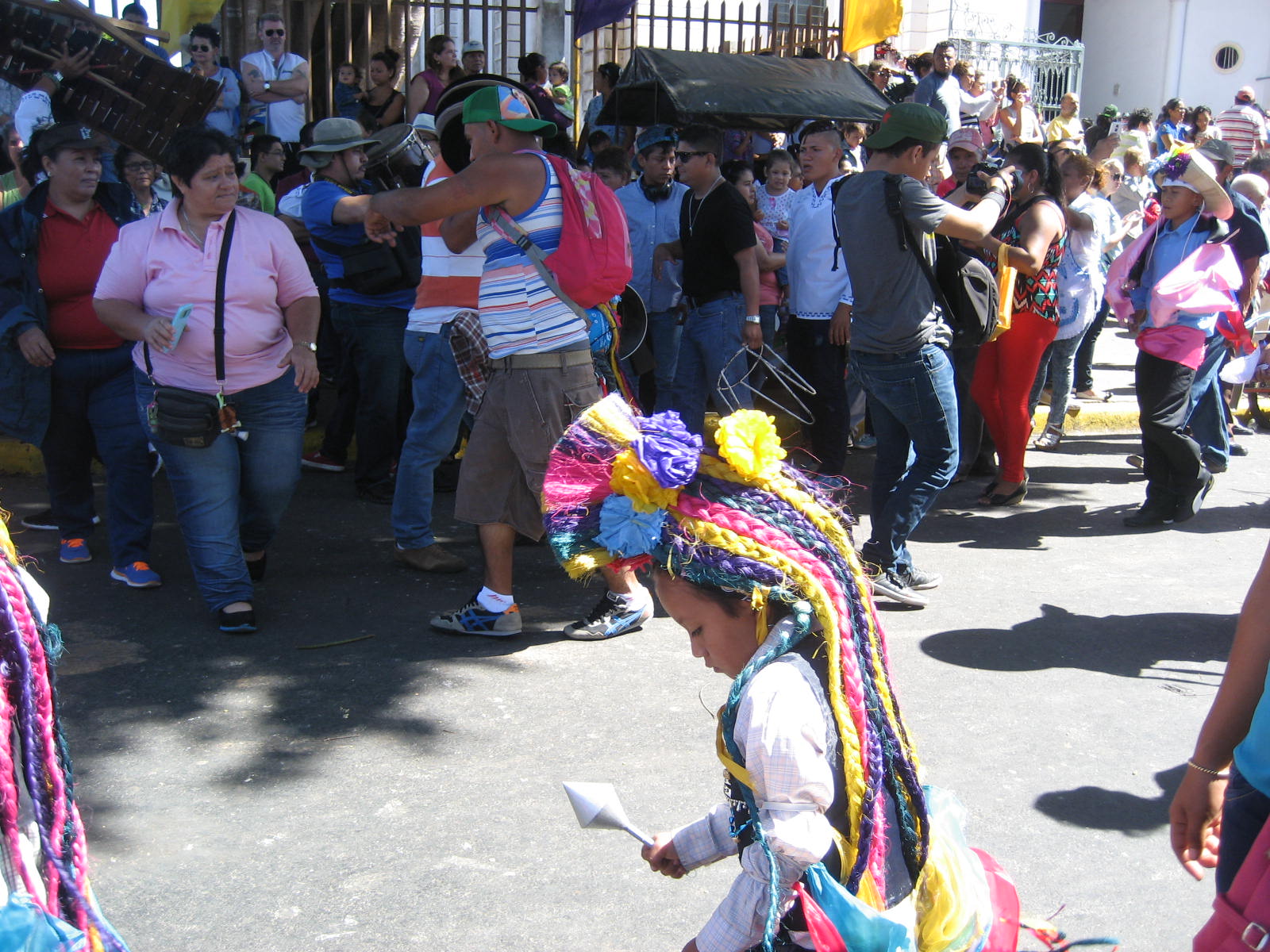
I spent last Tuesday, the 19th, in town to see some of the traditional dances and costumes that date back some 300 years. These traditions are the oldest extant examples of cultural representation of the invading conquistadors and the indigenous people whose lives were ripped forever from their ancient foundations.

This St. Sebastian looks Garbo-esque, as the finishing touches are applied to the festival stage.


In the streets just beyond the Minor Basilica of St. Sebastian, the Güegüense traditional dance is a guiding spirit of Nicaraguan folklore, which celebrates both its indigenous and Spanish pedigrees. The costumes are elaborate, the hats heavy and ungainly, the carved wooden masks seem ghoulish and bizarre. Hot, too—I noticed performers lifting the masks to let in a bit of air from time to time.


The Güegüense (El Macho Raton—Macho Mouse) is a satiric production that lampoons stock characters such as a governor and a military captain, involving theater, dance and music. In 2005 it was declared by UNESCO as Oral and Intangible Heritage of Humanity. The original play was written anonymously in the 16th century, and handed down as an oral tradition, finally appearing in book form in 1942. Other traditional dances—The Old Man and the Old, El Gigante, Guacal (calabash gourd)(the Inditas), and El Toro Huaco (The Toothless Bull). 

Small musical ensembles abounded.


Here's a lame web promotion of El Güegüense


And more pix of costumes and dancing!


This little horsy lost his mask, but his mane is magnificent!


Sunday, January 17, 2016

A Spay Odyssey

"Are you sure you want to do this," asked the veterinarian in Spanish. "She could be worth a lot of money to you in puppies."

No, I was not feeling at all sure I wanted to spay Brynn. But not because I thought I might want to breed her. For all I know, she is the only Pembroke Welsh Corgi in all of Nicaragua, though I think I might have seen one in Managua. My hesitancy was more immediate. I looked around the modest vet office, at all the typical dusty dirt on the floor, on the counter, clinging to every surface. The medicine case was well-stocked with drugs and remedies for every sort of farm animal, dogs, cats, and birds. Marvin, the vet, also known as "Gato," for his dark blue (cat's) eyes, has the physique of an avid soccer player, with handfuls of long dark curly hair, and an infectious smile. He seems a tad hyperactive and talks so fast, I needed help from my friend Rey, who is Marvin's cousin, to translate.

My heart was in my throat as Gato filled a syringe and jabbed it into Brynn's hind leg, something to make her drowsy. Gato did not ask me if she had fasted (she had) or how much she weighs. He gave her a second shot to knock her out, and carried her limp body back into another room. All I could do was sit on the tattered sofa, admiring the many soccer trophies lined up against the wall, and talking to Rey and his wife Mildred for about a half hour. I was spaying Brynn in an excess of caution to try and forestall the cancer that claimed the life of my first corgi, Sugarbunny. I knew that most vets' facilities here are a far cry from the antiseptic, well-equipped and staffed clinics in the U.S., but I also believe that much of the sterility of those lavishly appointed suites is for the comfort and benefit of the pet owners. Surely it is possible to create a sterile field on a table for a surgery, and I crossed my fingers to make it so.

When Gato brought Brynn out to me, she was limp, tongue lolling, her belly orange from the disinfectant, with a neat incision in the center. Gato wrote out instructions for medicines and care, and charged me $40. We went home in a taxi. No sleeping in the dirt with the other dogs for the next few days for Brynn. She was not cooperative with her tummy swabs or pills, but her appetite soon returned, and now, six days later, she is more herself than ever.

Phew.


Wednesday, January 6, 2016

Life Cycle


I am of two minds regarding my status as a jubilada, a retired person. Part of me has long dreaded the idea of retirement because of the whole "advanced age" thing, this nearness to death, the final stage, the very winter of my life. Of course, there was a long time when I viewed an age in the mid-60s as downright decrepit. The other, much smarter part of me realizes that I may easily live quite vibrantly another 20 or 25 years, with luck, and isn't it marvelous to have so few responsibilities in this relatively youthful stage of the last third of my life?

This afternoon, I had a half-cantaloupe for lunch. I put aside the scooped-out remains while I was working at my laptop. Some flies gathered to feast on the leftover melon, and I briefly considered its removal to the waste can. Then, a brightly painted butterfly alit, its torn wings still brilliant with vivid shades of yellow, orange, black and white suggested that it was nearing the end of its lifespan. The butterfly extended its proboscis and tucked in to the cantaloupe flesh, flexing its wings now and then, leisurely enjoying the sweetness. It loitered thusly for a good ten minutes, and then flew off for awhile before returning to renew its addresses to the melon.

I wondered if the butterfly had an instinctive understanding that it was not long for this world. I wondered if it would linger as long as the melon rind were available, hoping to be nicely sated at the moment of death. Or was it just tired after meeting its obligation to mate and lay eggs for the next cycle of butterfly life, and just wanted to relax and drink? It sat on my table, returning to the melon again and again. Such a lovely creature. I crept away to get my camera, and when I returned, the butterfly had flown. An internet pic will have to suffice.

Is it too early for a glass of wine?