Saturday, July 24, 2021

Who Knows Where the Time Goes?

In those first few months of quarantine 2020, it seemed impossible to establish a routine that felt remotely like productive life.   The idleness of my days weighed on me and, far from itching to get going on something, my energy level flattened out and I abandoned nearly all pretext of useful pursuits. My reading was my salvation; I tore through novels of Elena Ferrante and Carlos Ruiz Zafon, Turgenev and Hardy, Kazuo Ishiguro and Edith Wharton. Jeff Bezos finally got his rocket off the ground thanks to my Kindle addiction, I'm sure. I finally had decent internet service, so Netflix ate up a good portion of those empty days. My laziness precluded gardening, and the weeds flourished. To my shame,  I recklessly took shovel in hand into the bright sun and tackled the offending verdure, only to collapse gasping in front of the open refrigerator after just twenty minutes. 

Last week, I received a notice from the San Marcos post office saying something had arrived with my name on it. This was earthshaking, really. The Managua airport had been closed for much of the quarantine period, which meant that no mail service from outside the country was possible. Over the past couple of months, though, some service had resumed with other Central American carriers, including some flights to Miami, so mail could trickle through. When I picked up my envelope, I had to laugh.  It reminded me that after my failed gardening effort in May, 2020, I had perused seed catalogues online to try and feed the tiny flame of interest in growing anything. I remember looking through several US-based vendors only to find that they were running out of most of the herbs I wanted to order. It seemed that Americans were not only baking sourdough bread, but also tillling up their yards to fill their quarantine days. No dill, no basil, no curly parsley.  Eventually I did find a dealer with herbs in stock, in Devon, England. So I ordered five packets of seeds at an outrageous price (that included free shipping anywhere in the world!) and, well, time passed. My garden withered. Sloth reigned, Mr. Besos built another rocket.

Pathetic, but scads of potential...


I laughed to see Devon, England on the return address. The order was dated May, 2020, and though I had long forgotten all about it, my seeds had fought their way around the world to arrive in July, 2021. In pristine condition, I might add. Heaven knows in what sack or cubbyhole in what country they hibernated for fourteen months. I wasn't even sure if they would sprout a full year after their designated growing season.

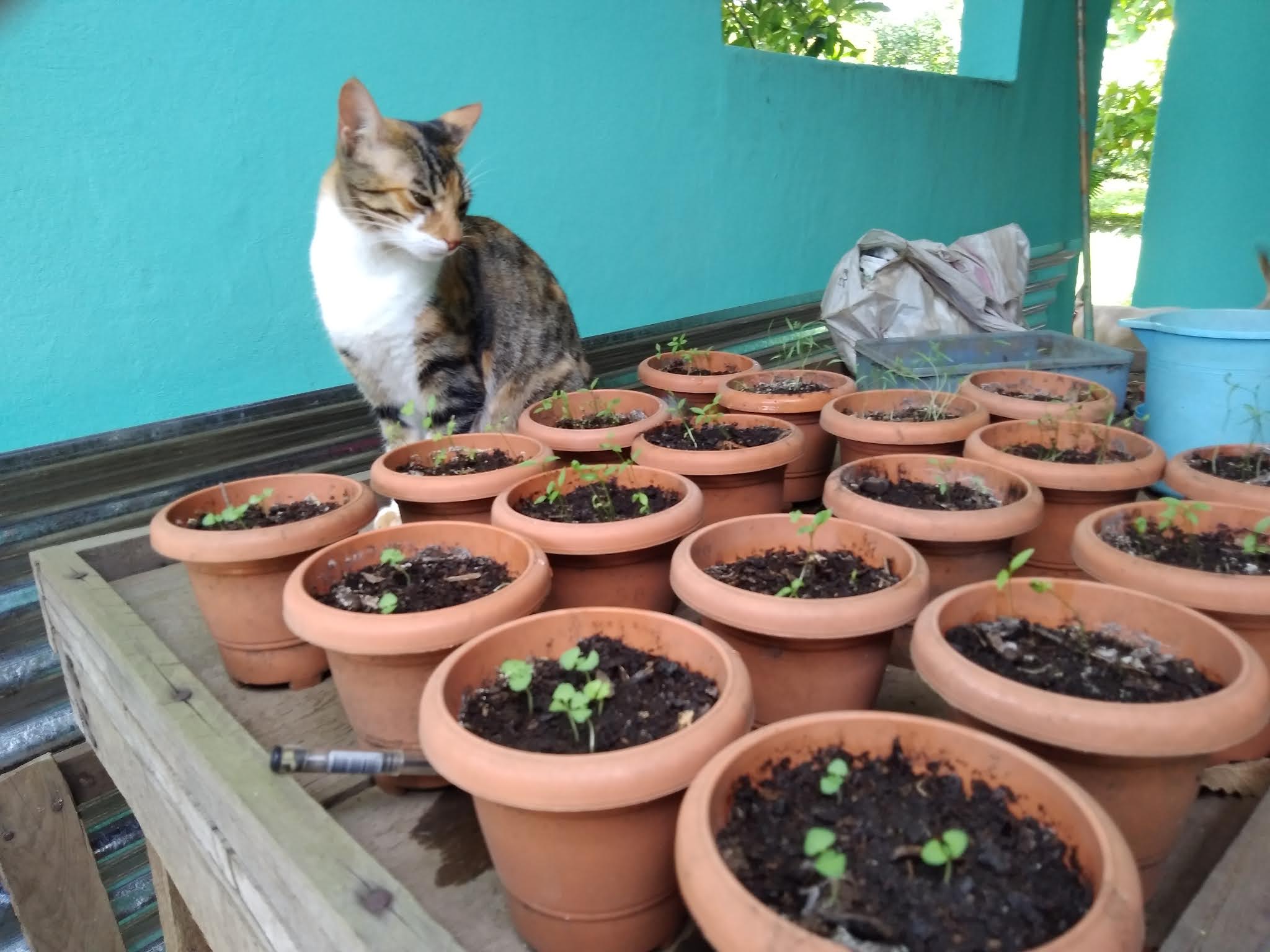
We'll see...  Basil, Italian parsley, curly parsley, dill and rosemary. I'm hoping I can update this post with luscious seedlings before too long. Fingers crossed.

Go, team, go!

And three weeks later...

Tootie Frootie on guard!

Wednesday, February 3, 2021

Rummage Chapter Two

 My dad was a builder who, for more than two years, spent his evenings and weekends nailing together our new house in then-growing State College, home of Penn State's main campus. I was in kindergarten in Bellefonte, and I recall feeling proud that my daddy provided blocks of wood of all sizes for my class to play with. I also remember traipsing around the construction site before our house was finished. It was located on Homan Avenue, at the time the edge of town, backing onto disused farmland.  When we moved to State College, I and my brothers used to cross over the field to an old barn to catch pigeons and scare ourselves silly at the sight of long-dead rats strung up, presumably to deter young trespassers.

Our new house was simply wonderful! It was a modern split-level, with plenty of room for Mother's piano and a Christmas tree. Because the house site had so recently been farmland, we were plagued with mice. I clearly recall spreading out to read the funnies on the livingroom rug, and watching as cute little baby mice toddled across the newspaper. My sister Anne was born soon after we moved in, and I was pretty thrilled to have a real babydoll to care for. Had I known at the time that three more babies would follow over the next nine years, I might have been less thrilled to begin my 12-year career as Mother's assistant. But when I was six, I was over the moon to have a baby sister.

Mother had five kids now, but she made time to take courses in library science at Penn State. Dad was the superintendent of construction of what was then to become the Military Science Building on the campus. Between time spent haunting the main library with Mom, and visiting the job site with Dad, the campus was a familiar second home. One year, I participated in a university-sponsored children's television show called "Keys to the Cupboard," in which my group created a whole circus tent full of clay figures of lions, horses, acrobats and highwire artists. When the project was finished, the circus was raffled and I won! I have no further memory of the tent and its contents. It probably ended up in the trash bin after being played with once or twice.

Our mother was a musician -- she had a lovely warm soprano voice, and had been a music teacher in Boston for a year prior to her marriage. She gave voice lessons in our living room, though how she managed to keep five children quiet and out of sight is a mystery. I can still hear the fog-horn voice of one of her students torturing "Beautiful Dreamer."  Mother and her brother Bill were both excellent singers and organists at their respective churches, and sang as well with a group of madrigal enthusiasts based in State College. They called themselves "Pro Nobis," and took turns hosting evening rehearsals. I begged to be allowed to stay up when they met at our house. One December, they gathered to hear a recording of a new Menotti opera, "Amahl and the Night Visitors." The story of the poor shepherd boy who meets the Magi was utterly enchanting. Shortly after the first scene, I was sent off to bed, most unwillingly. Next morning, Mother told me that Father Hovanec, who sang tenor in Pro Nobis, had left the recording for me to keep. My first record! I wore it out over the next months, and I still get a thrill when I hear it to this day. "This is my box. This is my box. I never travel without my box!"

Our happy times in State College were cut short when my dad was transferred following completion of the Military Science Building. Near the end of third grade at Easterly Parkway Elementary, I had to leave my first friends on Homan Avenue and all of our near relations in close-by Bellefonte, to travel to Canonsburg in far-Western Pennsylvania. Today, the university campus is much changed, bigger; the town itself is vastly larger. No more farmland next to Homan, just miles and miles of suburban development. Go figure...

Monday, January 25, 2021

A Rummage in the Archives

 Long days of quarantine alone in my little house in Carazo have lulled me into meditative introspection, as they doubtless have nearly everyone with too much unoccupied time and too little human conversation. It is familiar territory by now, as mine has been largely a life of the mind for these past five years. Lately, though, I am increasingly conscious of the tenuousness of my recollections, which will surely vanish when I do. It is surely a normal preoccupation of people in the "third age," as it is called here on signs directing disabled, pregnant or elderly customers to use a designated window at the bank. 

I have been giving myself guided meditations, visiting various places in my past to try and re-experience the feel, the ambience, the smells and sensations that float up and put me in touch with my younger self. I barely recall the little row house I lived in for the first five years of my life. It is instead my grandmother's house that framed my childhood in Bellefonte, Pennsylvania.

Because my parents produced their first four children in rapid succession, and I, second-born, needed the attentions of a distant eye surgeon over several years, it often fell to my Nana to take me to doctor's appontments in Sunbury, PA. She drove a large Buick, with my taciturn grandfather, "Pop," in the passenger seat, smoking. I sat behind, often wedged between sisters of the Immaculate Heart of Mary, who happily accepted a ride between convents in Bellefonte and Sunbury. Happily, that is, until my carsickness erupted and I barfed all over their neat black habits. I can still smell that awful cigar smoke, but I dared not complain. My grandmother brooked no nonsense from children. She certainly loved us all, but she was a rather starchy sort of lady with strict expectations that I knew to respect. Once I started school, Easter vacation/Holy Week became my special time to visit Nana. She was a convert to Catholicism, meaning she attended every single service and ritual, and those were some very long hours on the kneeler in the family pew at Saint John the Evangelist church. But she also took me shopping for a nice outfit and new shoes and hat, and I loved being in her gracious home, which had been one of the first to acquire electricity back in the day. Plus, Nana had a television!  My parents resisted buying a boob tube until I was fifteen. Until then, it was only at Nana's or my Aunt Eleanor's house that I could watch TV. At Nana's, that meant Lawrence Welk, Perry Mason, and Gunsmoke. Aunt Eleanor let me watch The Twilight Zone with my cousins Debbie and Katie. (O, the nightmares!)  She also had a record of the Peruvian singer Yma Sumac that I never tired of hearing!

When I was five, Nana took me to Geisinger Medical Center in Danville for the second of three eye surgeries to correct strabismus. I distinctly remember being changed into pajamas, and taken to a playroom where an older boy was dragooned into helping me eat lunch. I felt incredibly special to have his attentions, and never noticed Nana's departure. My parents were under orders not to visit me following the surgery, to avoid having me cry, I expect. My mother's younger brother Bill, unaware of the order, decided to visit me on his way back from Philadelphia, and I remember being so happy to see him. I had a third surgery when I was eight. My happiest childhood memories are of my mother reading to me during the two-week periods when I was functionally blind after returning home from Danville. She read "Heidi" when I was five, and "Little Women" after the third operation. How she wrested time from caring for four young children to read whole books to me is a mystery. But it made a lifelong voracious reader of me.


Wednesday, January 20, 2021

Living History

 Today was indeed history-making, and it leaves me sad that I will likely not be around long enough to remark on it once sufficient time has passed to make it history. Unlike the dreadful day in 1963, when I was 12, and the PA system at Our Mother of Sorrows school in Johnstown crackled with the word of President Kennedy's assassination. JFK had been my first political idol, and though I felt devastated, I also had a clear sense of history being made, which gave me a bit of calming distance from the horror. I stared at the images during the funeral cortege and service, wanting to memorize every detail, knowing it was a transcendent moment in my young life.


I felt the same distance today from the absolute joy I wanted to feel at the historic events in Washington. The end of Trumpism and the swearing-in of Kamala Harris, who covers so many "firsts" in our history all by herself, was overwhelmingly emotional, yet tinged with the certainty that dear old Joe has a mighty long row to hoe. And I want to live long enough to see if the country emerges stronger, healthier, and more unified from what will take years, perhaps decades to accomplish. IF it happens at all. My confidence in the basic good will of my fellow Americans has been deeply shaken, and for every step in the direction of equality for all Americans, I see a two-step backlash. That half the citizenry would gladly follow a proven grifter, a shameless corrupt and incompetent huckster, mystifies and frightens me. They have fallen wholesale for the notion that Democrats are (shudder!) socialists, which has been effectively conflated with communists, and they cling to the thread-like hope one day to become part of the one percent at whom all those tax breaks and business deductions are really directed.

Not only do I sense this historic distance from today's events, I also feel the geographic distance as an ex-pat living in one of the ten worst-governed countries, according to La Prensa. My income level insulates me from the worst the dictatorship has wreaked on daily life for most Nicaraguans, but I have eyes and ears. Notably, jingoism and rampant nationalism are not in evidence here to the degree I see in the U.S. Racism either. Crimes of need, sure. Femicide, in a culture of machismo, yes. But nobody wants to interfere in another country's business, nobody feels entitled to crow about exceptionalism of any kind. And like most Americans, people here want decent housing, food on the table, reliable utilities, education, and healthcare. The rest is gravy. And why should they not aspire to gravy? And decent governance. 

Well, Joe, work to do. Work to do.


Thursday, January 14, 2021

And then, she woke up...

 After ten interminable months in quarantine, not to mention four years of trumpian tyranny, something finally made me feel like posting anew. Nothing special has happened to warrant this sudden and unexpected turn, save for a technological earthquake of sorts, for the better. My online life of the past two years has been limited to the snail-speed of a used HP mini-laptop I purchased when my other machine died. Not only was it used, it was used in Spanish, and though it converted to English with little fuss, the keyboard functions were unfamiliar to me. Although I did eventually sort out semi-colons and dashes, parentheses and slashes, I never felt unconstrained by my clumsy fingerings and those exhausting delays, waiting for pages to load, or websites to appear. I dare not estimate how many days, nay months, of my now-limited life I have wasted watching the little round loading arrow spin and spin and spin.

My plumeria blossoms -- Sacuanjoches - were wonderful in 2020!


Yesterday, masked and washed, I ventured out to Managua for the first time since last February. I needed to visit the Office of Immigration to inquire about renewing my five-year residency, which expires this April. (Where have these five years gone already?) My wonderful driver Julio -- who has ferried me to the bank, the grocery, and the electric company since last March, (when riding the bus became dangerous to health) -- took me and my lawyer Noel to Imagracion, then to Wal-Mart to pick up duct tape and light bulbs, and then to Metro-Centro, the big shopping mall in the old downtown section that had been leveled by the 1971 earthquake. Metro-Centro is a popular site for demonstrations, which sometimes turn violent. Except that now a daily presence of riot police with shields and guns are on prominent display at the entrance. So, no demonstrations yesterday, but I did finally break down and buy a new computer. More on that in a minute. We capped off the visit to Managua with a rum-and-Coke-fueled lunch with my friends Ivan and Erlinda, whom I have missed for the past year of enforced solitude. What joy, to laugh and talk and catch up on news. I had almost forgotten how nice it is to visit a restaurant and meet up with good friends. It rocks, really! Lordy, I hope Covid did not find me...

Then this morning, I rediscovered the dizzy delight of surfing from one site to another in the blink of an eye, of listening to NPR without losing the audio everytime I added a tab or opened a document. Oh, how I have missed the ease of connection I now enjoy. And I have shelved the replacement keyboard I've had to use since the HP mini's gave out a year ago. And all of a sudden I felt like expressing myself a little. I have no idea if this impulse will last, but for the moment, I almost feel as if I have something to say. 

Stay tuned?


Friday, June 7, 2019

Bereft

In 1977, I was part of a creative team at Pittsburgh Laboratory Theater. We were planning a production of The Ruling Class, and I was stage managing. The central character was played by Bingo O'Malley, who immediately became one of my closest friends. During the run of the play, I took over a bit part and had the sublime pleasure of doing '"The Varsity Drag" number with Bingo et al. Over the ensuing years, Bingo and I enjoyed my free passes to Pgh. Pirate games, studied sign language together, joined his large raucous Irish family for Sunday afternoon Steelers' broadcasts, went rafting down the Youghiogheny white water, formed a scene study group called Stage Left, Pittsburgh, which also produced a few plays. Those years were especially precious, as our splendid circle of friends packed so much enjoyment into the monthly meetings, which absolutely included good food, juicy gossip, occasional tears, and plenty of laughter.

Bingo was a gifted actor whose instinctive artistry created layered performances in every role he took on. He and I played a warped husband and wife in an absurdist nightmare by Boris Vian called The Empire Builders at the Lab Theater. Some years later, I directed him in The Subject Was Roses, during which he became ill with what turned out to be hepatitis. He refused to quit rehearsing, all the way through final dress. The play never opened. He nearly died.

I left Pittsburgh in 2000, focusing on raising my son and spending my parents' last years close by near Johnstown. I kept in loose touch with Bingo. When his sister Kathleen died unexpectedly, moments after a joyful reunion as Bingo returned from a stint in a Kentucky production, a mutual friend called and urged me to contact him. Bingo was devastated; he never could handle the idea of death. And Kathleen had been a rare joy of a sister and best friend. Once, when I bought my first house, I had a pre-moving-in party at a time when Bingo had (shockingly) shaved off his beard to play the Pittsburgh artist John Kane on PBS.  Kathleen was enjoying the party, and spent some minutes talking to a new friend before she realized he was actually her brother, unrecognizable without the whiskers!

I saw Bingo a couple of times more when I would happen to be in Pittsburgh. His theater career flourished, including a tour of Ireland in a Brian Friel play, which must have been an ecstatic experience for him. I last saw Bingo at a one woman show by our mutual friend Barbara Russell. Being with him was as stimulating and satisfying as ever. Intervening years vanished and we caught up on each other's news with gusto. His charm and playful manner had never dimmed, and I distinctly recall telling him how much I loved him as we hugged goodbye. Somehow, I guessed that I would not want to leave that unsaid. The next few years passed. He stopped performing in his 80s, and I moved to Nicaragua. And yesterday came word of his death.

I had contacted a mutual friend through Facebook to get word of Bingo's status a few months ago. I guess that friendship has withered, as I never heard back. (Fuck you, Chris.) And now, this world is a much poorer place without my extraordinary friend Bingo, with his steely, frequently twinkling eyes, his impossibly erect posture, his truthfulness, his intense loyalty.

I've turned my house over vainly searching for a favorite photo taken in the Pirates' dugout just before I threw out the first pitch one summer evening. Bingo and I were chatting with manager Chuck Tanner, both of us giddy with excitement at sitting in the dugout! Here instead is a snapshot taken at Pittsburgh club Graffiti, when Luis Clemente, son of the great Roberto, was performing with me and my friends to raise money for my Nica sport project. Here we are together, in 1990, I think, in a badly lit, but precious memento.


16 February 2020 --
Found that photo -- note: I have just been taught how to hold the ball with forked fingers... we are both listening intently to Chuck Tanner explain the meaning of life. Miss you so much, Bingo.


Friday, February 8, 2019

Losing My Virginity

When, in April, 2016, I moved into this house in the Carazo hills, I had hooks installed on the front porch for my hammock, which I had bought in Masaya on a shopping trip with brother Bobby.
Then, my new housekeeper suggested I keep the hammock inside the house when I was not using it, as some unscrupulous ladron might help himself to it under cover of night. I ignored this advice as  it would have resulted in my never using the hammock at all. That was nearly three years ago.

July 2016 - My friend Ivan and his son Parzi, with Susie and Brynn, at our 4th of July party.

Last night, the ladron finally showed up. I feel certain that lovely hammock is today worth much less than when this photo was taken. Three years' dry season dust accumulation has rendered the hammock a grungy grey, and our latest puppy, Lolita, has found the decorative fringe irresistible for gnawing, chewing and pulling apart into glorious shreds.

In truth, my robbery record in Pittsburgh dwarfs this solo event. Over 12 years in the Oakland section of Pittsburgh, I was burglarized five times. That works out to five stereo systems (Yeah, I know. "What's a stereo system, Mom?"), four televisions, various cameras and lenses, a microwave oven. And my cherished medieval lute. Sigh.

My garden hose is also AWOL this morning.  I can pick up a new one when I go shopping for a bear trap to set nightly as a welcome mat for my next nefarious visitation. Now that my robbery-free record has been stolen, can the next time be far off?

Thursday, December 13, 2018

And She's Buying a Stairway to...

Two weeks ago, the now year-long construction project to widen the Panamerican Highway from two to four lanes made it to my literal doorstep. I awoke to the rumble roar of heavy equipment. When I went to open the door in the great sliding porton through which cars may enter or exit the property, I found it tied shut with heavy wire. Through the crack, I could see that the expanse between my wall and the existing highway had been excavated, leaving a deep earthen gap. I tried to squeeze my arm through the crack to alert the crew that there was a person imprisoned therein, to no avail. I was stuck inside for the weekend.

Happily, I had no plans to leave and had plenty of food. Alas, the electricity was turned off, so I had to carefully measure out my computer time, and with no pump for inside water, no showers or flushing. I briefly considered the possibility of a stroke or heart attack, but decided to read instead. Thus passed two days of clanking, bumpedy-bump grinding din from beyond the wall, and hours of excited barking within.

Monday morning, Maria José arrived at her usual time, and simply untied the door and let herself in. I do admire her anarchismo! Her brother cobbled together a little stairway of stones and earth to help me negotiate the drop to cross the gap to the road. It worked well when I left on Tuesday morning to go to San Marcos for tutoring duty. When I returned, the road crew were hard at work, having unceremoniously destroyed the stair. Two days later, I turned my ankle trying to get down from the wall, so Thursday's trip to San Marcos did not happen.

After endless hours of rolling back and forth, compacting the earth, the bulldozer disappeared for some days. MJ's husband Jonathan seemed to think the gash in front of my wall would be there at least two months. Months?  He rebuilt the little stair, adding a nifty handrail of scrap lumber. The next morning, the bulldozer returned, and while it left the stair intact, it neatly sideswiped the rail and snapped it off before my eyes. Anarchy works both ways.

Yesterday, Maria José and I went shopping in San Marcos, When we returned, the heavy equipment was back, with a big backhoe digging out the gap even deeper!  The steps, needless to say, were history, and when one of the crew helped us across with our parcels, he assured me that my path would be leveled before they left. And it was!


Looking north from my porton.
13 Dec.2018

Apparently, the backhoe is loading the dump truck at that end of the wall, and the earth is dumped at the other end. Why dig it up in the first place, I wonder.


And the backhoe looks like a dinosaur from inside the wall, hence the barking chorus!


The approaching holidays had me wishing to do somebody some good. I asked Maria José if she knew of someone who would be glad of a food donation. It took her no time to tell me about an old lady who cares for her adult mentally disabled son, with no income.  Our shopping trip yesterday began with the purchase of a plastic garbage can, which we filled with rice, beans, corn flour, oil and sugar, powdered milk, cleaning and hygiene supplies, and cookies. The lady will not know from whom the gift comes, but I hope it will give her some nights of good rest, comfort and joy.


Saturday, November 10, 2018

Had Enough?

I state the obvious that these posts are arriving with less frequency. This I chalk up to two realities in my somewhat spare existence here in Carazo. The first boils down to the rather severe limitations of my day to day life. I spend almost all my time at home, seeing no one save for the people who come to work in the garden or do housework. Twice each week, I go into San Marcos to do my tutoring shifts at Keiser University, and enjoy the opportunity to speak English. And once or twice a week, I go into Diriamba or Jinotepe to pay bills, shop for perishables, pick up medications, and buy a newspaper. I almost never do anything new, which was the point of many past postings here. I do plan a future trip to the east coast, the Costa Atlantica, to Bluefields to visit my old friend Carla, and that could give me the grist for a couple of entries. And one of these years, I really should go south to San Juan del Sur, a beach town with a large ex-pat community. People say it is a fun town, though I could not be less interested in going. Someday, when and if anyone ever visits me again...

The second reality is my waning relationship with the real world. I retain my need for news and views of the Motherland, but the first half of the tRump presidency has tarnished my sense of America and Americans.  Whatever is true of the US now, it bears little resemblance to the land I called my home for 64 years. It isn't just the Orange One; it is the millions of people who put him in charge and throng to his partisan rallies, and who hate people like me. I keep hearing about the blue urban areas, with their well-educated, well-heeled progressive voters. And the rural red zones, with (presumably) poorly educated, financially less-secure voters. And the gloves are really off now. Trump stokes the angry fires of resentment, fear, suspicion, and hatred to excite his fans and deepen the divisions between them and everyone else.

I wish I could understand why it is so important to so many that the U.S. be the "greatest country,"the richest, the most powerful, the best of the best of the best. Clearly, the U.S. is far from the best at, well, pick a category. Taking care of veterans, old people, and the indigent; making healthcare available to all; responsible stewardship of natural resources; reducing corruption in government and the justice system; fair and just enforcement of intelligent laws. I could go on and on. I think I have Denmark envy. Or perhaps Finland. Those populations seem so much more content to have small defense budgets and high taxes. They feel optimistic.They like the way their taxes are used to provide healthcare, education, welfare institutions.

By now, you are wishing I would just go back to travelogue posts, or none at all, for that matter. Perhaps this blog has run its course. I seem to have found a very small niche for myself that is not especially interesting or productive, a perch from which to watch the U.S. implode. It all makes me feel incredibly sad, and very forlorn.


Saturday, October 13, 2018

Listen to Me!

A friend writes that he suspects that the noise of electronic media has rendered even old-fashioned conversation suspect.

"Face to face with another person looking at them straight in the eye and talking just doesn’t seem to work because, in my estimation, the other person is just too distracted to have their voice hearing senses turned on and tuned in to another human voice  - I think it is because they fear missing some other information that may be coming, at any second, his way."


Think about it. A population so attuned (addicted) to the siren call of a text message beep or an email blip that they are incapable of truly listening to what a person standing right there is saying. 


This is distressingly sad, to me. Like my friend, I have thus far avoided the "smart phone" obsession, if not by design, by my sheer ignorance of how to use one. I can barely manage a flip phone, a necessity here in Nicaragua in the absence of landlines. I rarely carry it with me, as I almost never use it. I think I can count the texts I've sent on one hand!


This is a very poor country, to be sure, yet half the people seem to have cellphones -- are they even still called that? Here, as everywhere, the sidewalks are full of people hunched over their phones, scrolling away, ignoring the potholes in their paths. Or on the bus, earbuds in place, grooving to tunes while checking email or horoscopes. Thank goodness only half the people are living in digital reality. It is still possible to pass the time of day with disconnected individuals who wonder if it will rain or worry about rising bread prices.


Mind you, my demonstrated preference is for written communication. I like to think out what I want to say and find the best words to clearly communicate my thoughts. And I so appreciate a well turned phrase or piquant metaphor when I am reading another's thoughts on a page. But there are times when a person needs and deserves our unreserved attention. When one soul aches for intimate connection with another and only 100% concentration will suffice. If we lose the capacity to be one on one for as long as needed, we may well have lost the best aspect of being human.


We might think about reserving space for deliberate face-to-face communication, careful listening and hearing each other, in our busy schedules, so we do not lose this precious ability. Of course, I am not busy in the least. And heaven knows, I never hear the text beep. All I need is an actual person to listen to. Or perhaps my dogs.


Tuesday, August 14, 2018

Elementary?

And now for something completely different...

Reading books is my primary daily activity. I will happily read anything I find to be well written and interesting, and since the library at Keiser University has been closed all summer, I have invested in a Kindle. My bank account tends to limit my purchases to books costing less than $2.99, free if I am lucky. I read voraciously, so it is not unusual for me to churn through three or four good-sized texts per week. To my disappointment, I find the vast majority of Amazon's low-cost volumes to be popular action or romance gack, or spin-off genres like an enormous latter day supply of Jane Austen-inspired blather. Wading through the Kindle library is a troublesome bore, especially as my weak internet service takes forEVER to load each page! Yet, there are gems lurking there.

I was happy to see a 16-volume collection of English mystery works on offer for about a dollar a book, the first of which turned out to be a selection of Arthur Conan Doyle's stories of Sherlock Holmes, which I have just enjoyed over the past few days. It is hard to imagine a more perfectly realized, affectionately rendered, singularly memorable character than Holmes, with all his eccentricities, attitudes, failings and triumphs. Likewise, his faithful chronicler and frequent investigative cohort Dr. Watson establishes himself as the reader's trusted friend and confidant. He is ever ready to drop everything in service to his friend Sherlock, and respectfully records the various individuals and case studies they encounter with graceful language and only occasional lapses into melodramatic extravagance. Arthur Conan Doyle was not above the purple prose his readers loved, but Dr. Watson manages to surmount the temptation for the most part.

Something I have noticed about reading authors from more than a century ago is the characterization of people over the age of 50 as, well, elderly. At 67, I am only recently retired, and enjoying mature living, shall we say? But I hardly feel aged or particularly antediluvian. Dr. Watson's favorite descriptor seems to be "grizzled," or graying, as hair, if you will. It puts me in mind of a Rooster Cogburn-ish sort of rough, aging cowhand, but Watson even describes a "once-lovely woman of about 40" as grizzled. Well! He invariably describes most male characters as "handsome," though they may also have thick long beards (grizzled, usually) and bushy eyebrows. How does one find handsomeness under all that fur?

The episode in which Holmes meets his end (Or does he?) plummeting over a waterfall in a climactic struggle with his nemesis Moriarty allows Dr. Watson to express his tender affection and admiration for his extraordinary friend in some of Doyle's most lyrical writing. The author's creation of a longtime, occasionally fractious, but consummately loyal and trusting friendship between two quite different men as a conceit through which to spin his tales of mystery is a joy to read.

I do not know if this collection is comprehensive or if there are other Holmesian adventures to enjoy, but I must observe that only once in the whole of some 20 hours or so did Sherlock say "Elementary!"


Wednesday, August 8, 2018

Unreal News


This evening, I watched Channel 2, an Ortega-owned television channel, to see its version of the current situation in the country. After a story about some millions of dollars of aid from Taiwan for four national projects came an analysis of the state of affairs regarding Nicaraguan production of basic grains – rice, corn, beans and sugar. Smiling experts attested to bumper crops at good prices, with lots of footage showing mounds of corn, beans, etc. and many smiling workers. This was followed by a story about tobacco production, with footage of dozens of workers rolling cigars, smiling and rolling.

After a short break, a story about a new campaign by INTUR – the government tourism ministry – to promote, of all things, upcoming religious festivals. The irony being that the Ortega government has roundly criticized the country’s bishops and clergy for supporting the popular uprising. Another story featured lurid video of wounded and murdered victims of “terrorismo,” the latest descriptor of the uprising, put forth by Ortega in some recent U.S. cable news interviews.

Things have definitely quieted down, but I wonder how many citizens will turn out for the religious festivals this September. Tough to tell, as so many people feel proud of their towns’ festivals, and are devoted to their various denominations. Certainly, there will be few tourists. 80% of the country’s hotels have closed. Don’t nobody want to come to Nica now.

In the meantime, work continues on the project to expand the PanAmerican Highway from two to four lanes. A crew passed by the other day, cutting down trees that obstruct the planned expansion. The little tree just outside my porton is now no more. I guess I will step through the gate directly onto the righthand lane heading north when it is all finished.

Wednesday, July 25, 2018

For Now, Calm


Following the drama described in my last post, circumstances here in Carazo have returned largely to normal, as before the mid-April uprising and the ensuing tranques and defenses against the dreaded caminetas. The streets are again open to traffic and commerce, albeit a heavily-armed police presence, especially around banks, is now in evidence. The shops are full of people, street vendors are hard at it, and save for some blackened patches on the road surface from car fires, there is little testimony to the privation and terror of the preceding weeks.

The buses and microbuses are back to their original routes, although the fares have risen. It now costs 40 cordobas to Managua from Diriamba, a 33% increase; 15 from Las Esquinas to Jinotepe, up 50% from 10. The passengers seem not to be interested in discussing the absence of the tranques or the general return to apparent normalcy. What, I wonder, was the point of the struggles, the deaths, the sheer loss of jobs and income from the now devastated tourist economy?

There have been subsequent demonstrations elsewhere. Ortega is now blaming the paramilitaries for the violence toward the populace. He’s been studying Trump’s playbook. But nobody doubts that Ortega’s regime and the Sandinista party are bankrolling the camionetas and the snipers. The people’s representatives at the “Dialogo” table, set up by the bishops to negotiate a peaceful resolution with Ortega back in May, are suddenly being charged with terroristic crimes by a justice system tainted by and beholden to the Ortega regime. Brave individuals who stepped forward to articulate the people’s discontent, to assert their demands for an end to corruption and official thievery, are now sitting in jail awaiting trial for treason. It seems there is no tactic too ignoble to employ in Ortega’s shameless efforts to stamp out opposition to his tyranny.

And here in Carazo, there is little evidence that ignoble tactics are not effective. Todo está  tranquilo.

Thursday, July 12, 2018

Pagada

Travel to Toronto was less than convenient. My flight was canceled, a later flight left much later, and the 22-hour trip resulted in a somewhat blurry first few days. Somehow, the fish in Lake Ontario got over their not unreasonable fear of my famed piscatorial talents, and the local wineries survived the Beatty invasion, and a very good time was too soon relegated to the past tense. My return to Nicaragua was uneventful, thankfully.

During my absence, the violence continued. Within five days of my return, the government-paid paramilitaries and National Police forces descended on the Carazo district with deadly intent. The popular tranques in Diriamba and Jinotepe were besieged and dismantled, with more than 20 deaths, mainly of young men defending their towns. A dozen people, including journalists, sought sanctuary in the Basilica of Saint Sebastian in Diriamba.  A Catholic cardinal and the bishops of Managua and other dioceses traveled to Diriamba to liberate them, but a mob of masked Orteguistas and paramilitaries, armed with guns and machetes, attacked them viciously. The monsignor and priest of St. Sebastian were beaten. Journalists were attacked and their equipment destroyed.

Mrs. Daniel Ortega, also called vice president Rosario Murillo, described the incident as thoroughly "Christian." She is, unsurprisingly, the most hated woman in Nicaragua.

Pope John Paul II visited that Basilica. Christmas, 2016, my sister Mary Mary and I attended a beautiful midnight Mass there. I asked Maria José if there were Ortega supporters in Diriamba. She shrugged and said, "Pagada." Paid.  The local Sandinista party apparatchiks pay people to oppose the popular uprising. And beat elderly monsignors.

This is a very dirty civil war.

Wednesday, June 20, 2018

Duck, Duck, Duck the Gunfire

Prior to my (still hoped for) flight to Toronto this weekend, I still had one more gift to buy for a sibling. I knew what I wanted, but the shop in Diriamba where it sat in a display case has been shuttered for the past few days because of the armed gangs harassing local neighborhoods. I figured it was worth one more try, so I caught a microbus, which left me on the outer rim of Diriamba, since it could go no further. I got a motito for the rest of the trip, and, Hurray! The shop was open!

Purchases in hand, I stopped at the super, where some food was now available, grabbed another motito, and we headed off for home. Just as we reached the edge of the city, a passing moto warned my driver that the Las Esquinas tranque was under attack, and not to go there. It was lunchtime, so I told the driver to take me to Mi Bohia, a decent restaurant nearby. I figured if I had to wait to get home, I might as well have a nice lunch.

No sooner had I taken the first sip of a very cold beer when the loud rattle of gunfire erupted just outside the restaurant. We all -- I, the waiter, and the few other customers -- dropped to the floor. A fellow who worked there peered out the window and said a camioneta was there in the street, firing at a barricade in the next block.  He turned out the lights, and we waited through several more bursts of gunfire. When it seemed safe to sit up, lunch arrived and I calmly enjoyed my delicious red snapper, feeling as if I were starring  in a Fellini film. The gunfire returned, briefly. When I had paid my bill, the proprietress made a phone call to check on the situation in Las Esquinas. "You should wait here," she said. The fighting was still going on, so I sat there in the entryway for nearly another hour.  Finally, a motito came by, and said he could take me to the highway, where I could walk north in hopes of finding a microbus.

This photo of Ticuantepe from La Prensa gives a good idea of how cities like Diriamba are blocking the camionetas' access. 

When I started walking, it was nearly one-thirty, and the sun was intense. A couple of guys were also looking for a bus to Managua, and one offered to carry my shopping bag. It was hard for my old legs to keep up with two young men, but I soldiered on. We walked about 1.5 kilometers before we finally spotted a waiting micro. Sweaty shirt and burning feet. Oh, bliss!

The shooting was over in Las Esquinas, and the tranque was wide open. The micro dropped me off in front of my gate and I fairly somersaulted through the porton to quiet, safety, and home. I could never have imagined being in such a situation, but oddly, it seems almost manageable. You just have to make it home.

My fingers are crossed that I will travel safely to Managua, to the airport, and parts north with no trouble. Nothing is definite in the current atmosphere.  Wish me luck, please.

Friday, June 15, 2018

Strange New World


After yesterday’s national work stoppage, my trip to Diriamba this morning was an odd mix of eerie calm and unsettling evidence that the town has been transformed into a fortress. The death three days ago of a 15-year-old boy there, and continuing reports of attacks on tranques and ordinary civilians by the camionetas – small white pickup trucks carrying armed paramilitary thugs who shoot to kill at no discernible provocation– has caused many people to simply remain at home. Roads that lead from the center of town into neighborhoods have been closed to vehicular traffic to discourage the camionetas. Somewhere, there are stretches of newly unpaved roads, as the paving stones have been ripped up and used to build the barriers. In consequence, the motito that brought us to Diriamba had to take lengthy and circuitous detours to get us safely to the mercado.

Photo from La Prensa


The usual crowds of shoppers and vendors have thinned out. Many stores are closed, and although local farmers are selling their produce, the usual bounty that comes from the wholesalers in Managua cannot be delivered. There was rice today at the supermarket, but little else. No milk, cheese, eggs, meats, pasta, beans, canned goods – nada. Beer aplenty, and scotch—say no more, say no more!
And what has become the new normal: lines of semi tractor-trailers, simply standing idle on the main thoroughfares. I noticed a number of propped up engine hoods, and wondered how many of the big rigs simply die in place, or run out of fuel while idling for hours on end. 

My plans to join my siblings in Canada for a week are in jeopardy. The early morning flight I hope to take in a week has been canceled for several days by American Airlines, citing security concerns. My secret theory is that there are too many unsold seats lately, and by suspending a regular flight for a few days, a sold-out plane will result. Anyhow, they say rescheduling will not cost more, if another flight can be arranged. Fingers crossed. Hell, just getting to the airport is questionable.

Thursday, June 7, 2018

Travel Notes: Tranques for the Memories

When the tranques (barricades, TRANK-kays) first appeared, the big rigs pulled to the sides of the road to allow local traffic to pass, understanding that halting commercial transport of goods was the primary aim of the stoppage.  The little tuk tuks and bicicletas could pass, as well as motorcycles and taxis. Even the microbuses could manage to get through, going up one-way streets, on sidewalks, inching along just microns from the next vehicle.

No more. Today, the tranque returned to Las Esquinas, and the big semi tractor-trailers are stopped at all angles -- some actually parked perpendicular to the road -- to thwart every effort to pass through. In some cases, the rigs are parked so tightly to each other that even skinny pedestrians cannot pass. I do not blame them. Vegetables are rotting in their rigs, orders are likely being canceled. This is all very bad for business.

This morning, I caught a passing bicicleta to Las Esquinas, intending to take a bus to San Marcos to return some books to the Keiser University library. Somehow, by zigzagging through the standing trucks, we made it almost all the way, only to find that no buses could get through to San Marcos. I asked one of the tranquistas, a young guy with a bandanna masking his face, how far the stopped vehicles extended down the road to San Marcos . He thought perhaps a kilometer, and was quite sympathetic. So, I decided to walk as far as I could to see if, at some point, motitos were helping to get people into San Marcos. The tranque was composed of stacked paving blocks, and a large log, still smoking from being burnt. Other men helped me over the log with utmost courtesy, and I started down the road past the big rigs. Many drivers had slung hammocks beneath their trucks or between roadside trees, and were taking advantage of the opportunity to grab some zees. People were selling drinks and food. Eventually, it was clear that I would be halfway to San Marcos before the road opened up, if ever, so I turned back and found another bicicleta to take me home.


This photo of the tranque at Las Esquinas is from an article in the website Confidential.com.ni


Two hours later, the backup had reached well beyond my front gate. No traffic is headed north toward Managua. Hard to believe it's the PanAmerican Highway.

Looking north, toward Managua.


Looking south toward Diriamba


I have seen online posts that say gasoline is both scarce and costly. Some shelves in grocery stores are empty. The tranques are beginning to hurt ordinary Nicaraguans. Restaurants are closing. Tourism-based businesses are being shuttered. I've heard that banks are running out of money. Jobs are disappearing all over the country. When and where will it end?


Post scriptum, next day:
Maria José accompanied me as I tried again to get to San Marcos. We walked to Las Esquinas, where I bought some cold Cokes, which we passed out to some of the tranquistas. We continued on foot to Santa Clara, about two miles from my house. There, we were able to get on board a microbus which took us into San Marcos. Keiser U. was open, but only one entrance was available, another half-mile walk to the opposite end of the campus. My dogs were aching! We later went to the bank, so I could prepay July's rent, stopped at the grocery to buy Scotch (it had little else on offer) and we went to Casona, a nice restaurant, empty of customers, for lunch.

We grabbed a ride back to the line of trucks, about a half-mile out of Las Esquinas, and made it home on a bicicleta. With four new books and two bottles of whiskey, I'm set for the next week or so.

P.P.S. Monday, 11 June
Maria José informed me that there is no propane left in Diriamba or Las Esquinas, save for five filled tanks still available. Normally when I need propane, I exchange my empty tank for a filled one , but with half a tankful still, I decided to shell out $60 to purchase a filled tank, which should see me through September. Daily, I thank my lucky stars for Maria José.

Saturday, June 2, 2018

A Dangerous New Word


The internal strife in Nicaragua continues. The army is still mainly on the sidelines as hundreds of thousands of ordinary citizens, unarmed and determinedly peaceful, march to demonstrate their complete disgust with the Ortega government. The huge Mothers’ Day (this week in Nicaragua) crowd was estimated at 700,000, or one tenth the country’s population!

Uncredited photo from Facebook group.

Daily, I peruse the opposition newspaper La Prensa online. Its coverage, along with posts by Nicaraguans on a Facebook group site (Expats in Nicaragua) is my primary source of information about the protests. 

I learned a new word on La Prensa’s front page recently: francotirador. It means sniper. Which, in turn, neatly defines the government’s response to the public demonstrations. Hired Sandinista youth and, some say, Cuban mercenaries, well-equipped with Russian sharpshooter Dragunov rifles, fire both rubber bullets and live ammunition into the crowds, killing indiscriminately. The death toll reached 100 this week, with more than a thousand injured.

Imagine the U.S. or Canadian government hiring snipers to “discourage” public demonstrations.

Please take a moment and watch this short clip from the Mothers’ Day demonstrations. Then play it again with closed eyes. Then, try to measure the courage and determination of a people trying desperately to rid their country of its voracious power wielders, for the second time in less than forty years.

Wednesday, May 16, 2018

Trolls and Tolls


This morning, as I prepared to go to San Marcos to return some library books, my empleada Maria José told me that the “T” junction at Las Esquinas (where the road to San Marcos connects to the Pan American Highway) had been commandeered by a group of mainly young men, stopping traffic and charging money to be able to continue on. I wasn’t sure I heard her correctly; there is a National Police station right there at the intersection, and I could not believe such an anarchistic hijacking of the freeway would be tolerated.

True enough, when I hired a bicicleta to take me to the bus stop in Las Esquinas, traffic was backed up in all three directions. The bicicleta wove in and around the idling trucks and vans and brought me to a waiting motito, where the driver explained that the buses were not running. So I hopped in and went on to San Marcos.

The big news of the day was the beginning of “dialogo” in Managua, between the Ortega government and representatives of various rebellious factions from the continuing protests and government violence. A clear majority want Ortega to go, but the Sandinista party and those who are its functionaries are perforce loyal to Ortega. Nobody seems to expect anything particular to emerge from the dialogo, but it is seen as a victory to have forced Ortega to the table.

I stopped at the grocery after the library, and then found another motito back to Las Esquinas, where we were blocked by an even larger gang of mainly young men, who had laid big stones and pieces of wood across the road. The motito driver tried to get someone to let us through, without success. Someone set off some firecrackers, which elicited whoops and people running from further away. It was clear that the least disturbance could raise the excitement to uncomfortable levels. I paid him and got out to try and find a bicicleta. Then, suddenly, the blockade opened and some traffic was allowed to proceed, and the motito came by and picked me up again.

I asked the motito driver why the police were just standing around, watching the extortion for passage. “They are afraid,” he said. “The new gasoline tariff of 15% is why the men are getting the money.” I later read in La Prensa that these tranques --blockades-- were held at other major arteries in the country, protesting rising food costs, in addition to gasoline and propane.
From La Prensa

There were perhaps 50-60 men in the intersection. All along the highway to my front gate, onlookers were standing, watching. Half a kilometer to my house, another group of men had obstructed the highway with wood and palms.  The sound of trucks idling lasted for two days. No doubt, the usual food and drink sellers were doing brisk business.

This is a tense time. So many people whose poverty and powerlessness have become intolerable can be momentarily intoxicated by these moments of brute power and anarchy. Not exactly a harbinger of stable daily life, as the thunderous blast of firecrackers continues.


Tuesday, May 8, 2018

It's a Smaller World After All

My inquiries regarding line-of-sight internet came to nothing. It would have been possible, but the cost to install a 110-foot antenna would have been more than $1,600. My brief fantasy of working online for 10-12 hours per week for a Chinese linguistics concern as a native English speaker and having unlimited excellent reception of internet television screeched to an abrupt halt. Now, I have only BBC World news channel, which stretches about four hours of news programming into 24 through endless repetition. Is one channel in English enough to warrant paying for cable access every month? And my problems with shaky internet service remain. I had not realized how limiting it is to have no television AND very little streaming capability.

Suddenly, it has rained nightly for four days, or daily for four nights, if you prefer. Suddenly, dozens of roly-poly fat beetles appear out of the darkness, attracted by my reading lamp. The dogs chase them until they give up, exhausted, helpless on their backs, waggling their little legs until I sweep them up and dump them outside.

Keiser University has concluded its spring semester, which means I'll have no students to tutor until September. Suddenly, my small world has become microscopic. I definitely will be buying some more chickens.